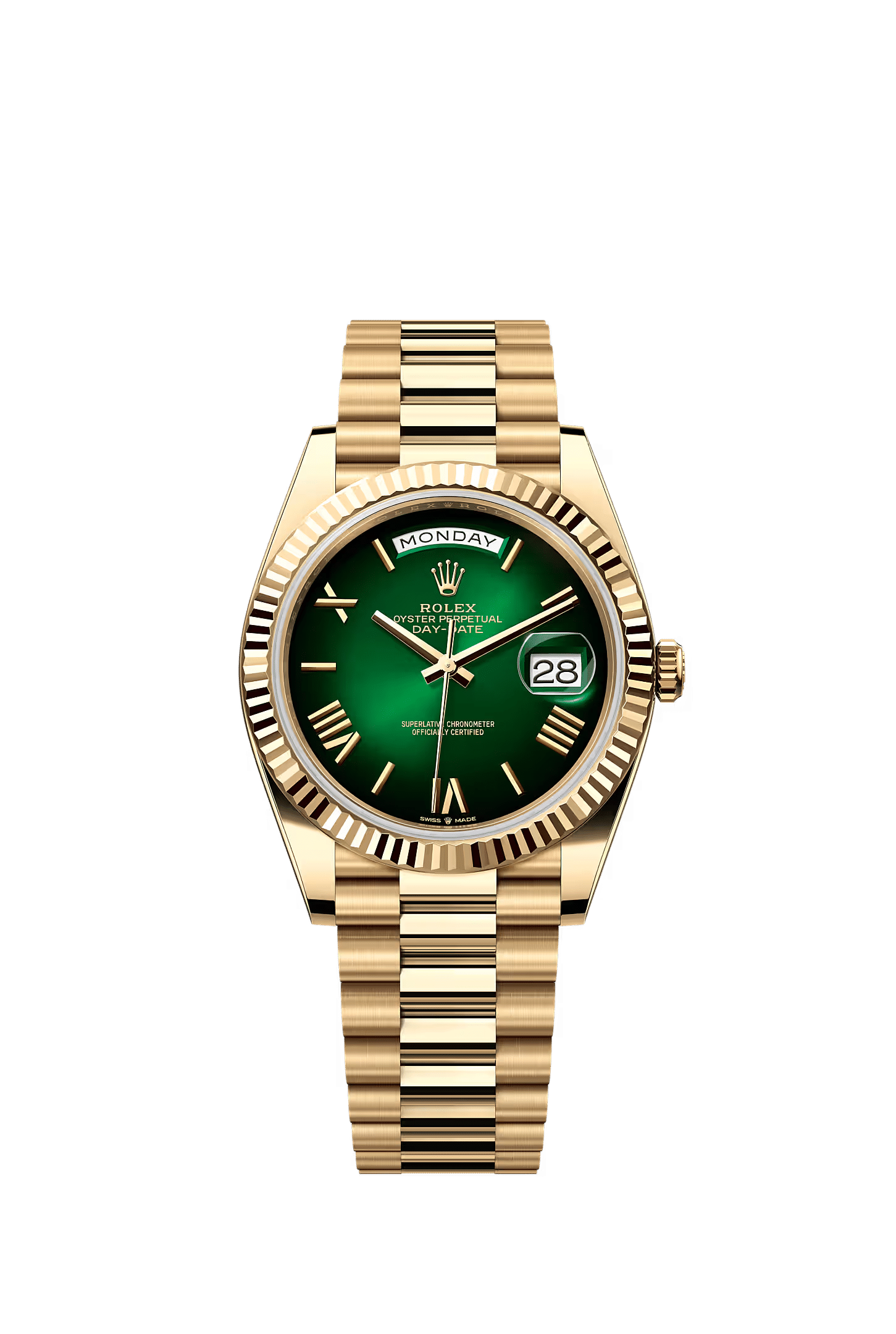
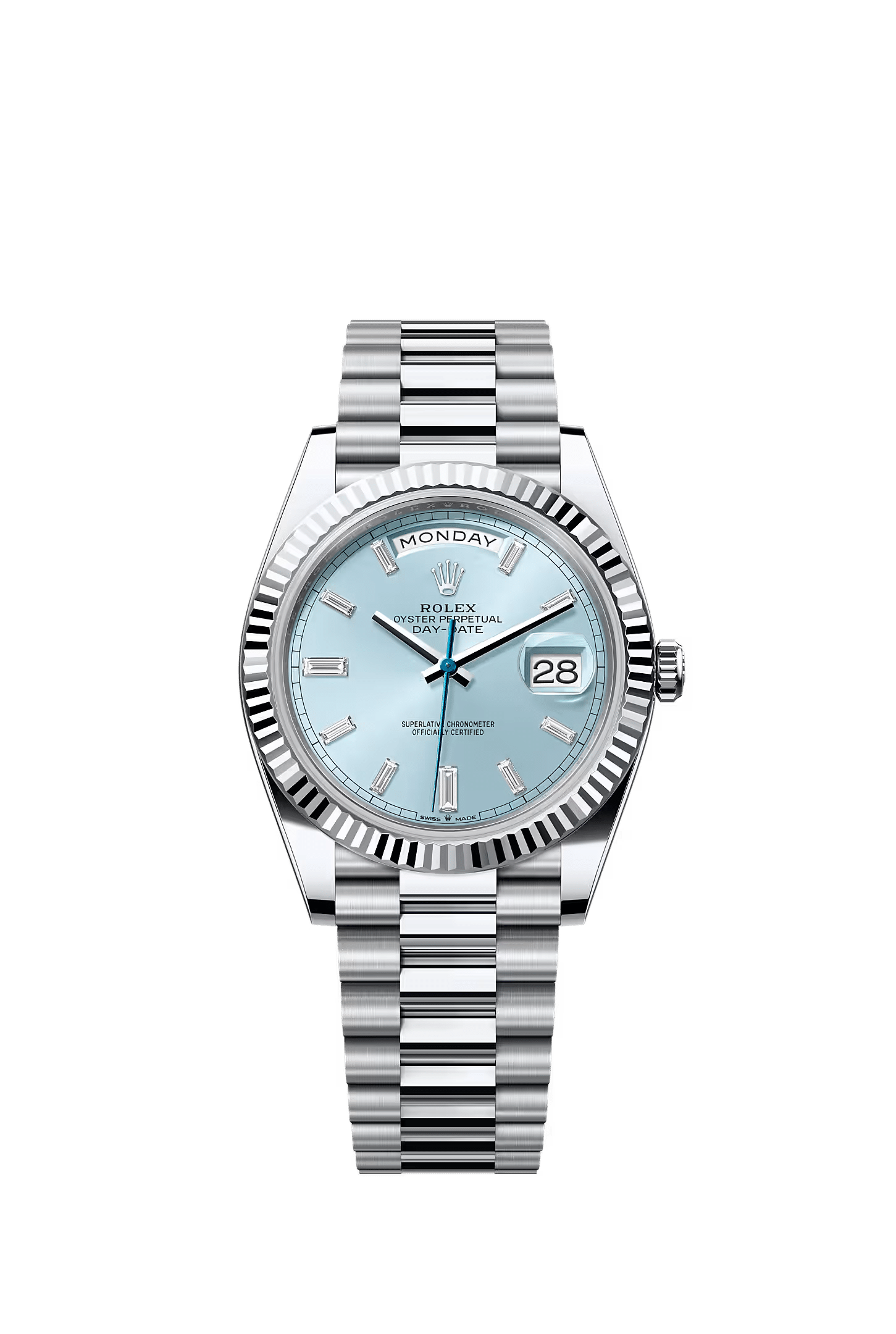
Few watches say as much as a Rolex Day-Date. It has only ever been made in gold or platinum, and when it was launched in 1956 it was the first wristwatch to show the day of the week spelled out in full on the dial. Its President bracelet was created for it in the same year, and the name has followed the watch ever since.
Because every Day-Date is made in precious metal, buying or selling one is a bigger decision than with most Rolex models. Size, metal, dial and bezel all change what a watch is worth, and small details decide whether a pre owned example is the right one. This guide explains the current Rolex Day-Date models, what to check before you buy and how to sell a Day-Date in London for a fair price.
The quick answer: the Rolex Day-Date is Rolex’s precious metal dress watch, made in 36 mm and 40 mm in 18 ct yellow, white or Everose gold, or 950 platinum. Today both sizes use calibre 3255, with a power reserve of about 70 hours. When you buy pre owned, check the reference, metal, dial, bracelet wear and paperwork. When you sell, a specialist dealer usually gives the best balance of price, speed and safety.
What makes the Rolex Day-Date different?
3 things set the Day-Date apart from every other Rolex.
- The day in full. The day of the week sits in an arched window at 12 o’clock, with the date at 3 o’clock under the Cyclops lens. Rolex offers the day in 26 languages, so you will find Day-Dates that read in Arabic, Chinese, French and many more.
- Only precious metals. There has never been a steel Day-Date. Every one is 18 ct gold or 950 platinum, which is why it feels noticeably heavier on the wrist than a steel Rolex.
- The President bracelet. The semi circular 3 piece links were designed for the Day-Date in 1956 and are still fitted to most models today. Rolex bracelet styles are covered in our guide to Rolex watch materials and terminology.
Inside, today’s Day-Date 36 and Day-Date 40 both use calibre 3255, a self winding movement made by Rolex with a power reserve of about 70 hours, and the Oyster case is water resistant to 100 metres, so it is a dress watch you can wear every day.
Day-Date 36 or Day-Date 40: which size suits you?
The Day-Date 36 keeps the size the model was launched with. The Day-Date 40 arrived in 2015, together with calibre 3255, and took over from the 41 mm Day-Date II. The 40 mm size is the more common choice today, and every Day-Date in our current stock is a 40 mm model, but the 36 mm version has a loyal following, especially with buyers who wear a watch under a shirt cuff.
| Day-Date 36 | Day-Date 40 | |
|---|---|---|
| Case diameter | 36 mm | 40 mm |
| In the range since | 1956 (the original size) | 2015 |
| Current movement | Calibre 3255, about 70 hours | Calibre 3255, about 70 hours |
| Recent references | 128238, 128235, 128239 | 228238, 228235, 228239, 228206 |
| Who it suits | Smaller wrists, a classic dress watch look | Average to larger wrists, more presence |
The best way to choose is to try both. Our Birchin Lane showroom usually has several Day-Date models in stock to try on.
How do the gold and platinum versions compare?
The last digit of a modern Day-Date reference tells you the metal. A 228238 is yellow gold, a 228235 is Everose gold and a 228239 is white gold, while platinum models carry references such as 228206 and 228236.
| Metal | Day-Date 40 example | What to know |
|---|---|---|
| 18 ct yellow gold | 228238 | The classic Day-Date look. Champagne, green and silver dials are popular choices. |
| 18 ct Everose gold | 228235 | Rolex’s own pink gold alloy. It pairs well with chocolate, olive and ombré dials. |
| 18 ct white gold | 228239 | Looks like steel at first glance, so it is the most discreet Day-Date. |
| 950 platinum | 228206, 228236 | The heaviest and usually the most valuable. Rolex reserves its ice blue dial for platinum models. |
Which dials and bezels draw the most interest?
The fluted bezel is the Day-Date’s signature, and it is what most buyers picture. Smooth bezels and diamond set bezels are also made, and they suit anyone who wants a quieter or more dressed up look.
Dials are where Day-Dates differ most. Ombré dials, which darken from the centre towards the edge, have become very popular in green and chocolate. Olive green, champagne and silver dials are long standing favourites, and baguette or diamond hour markers add sparkle without a gem set bezel. Because dials change value so much, always check that the dial is the one listed on the paperwork.
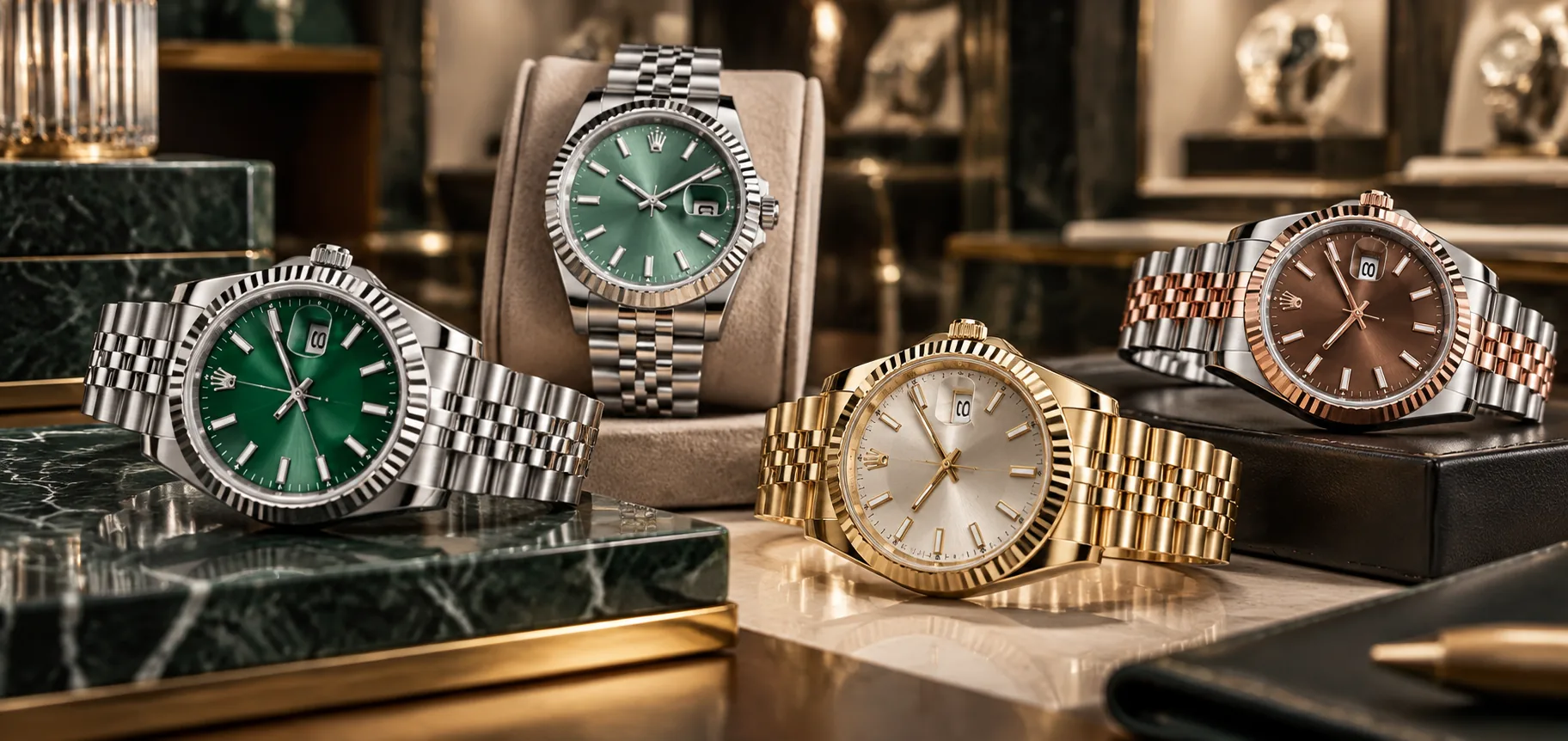
These are some of the Day-Date models currently in stock. You can see every model on our Rolex Day-Date watches page.
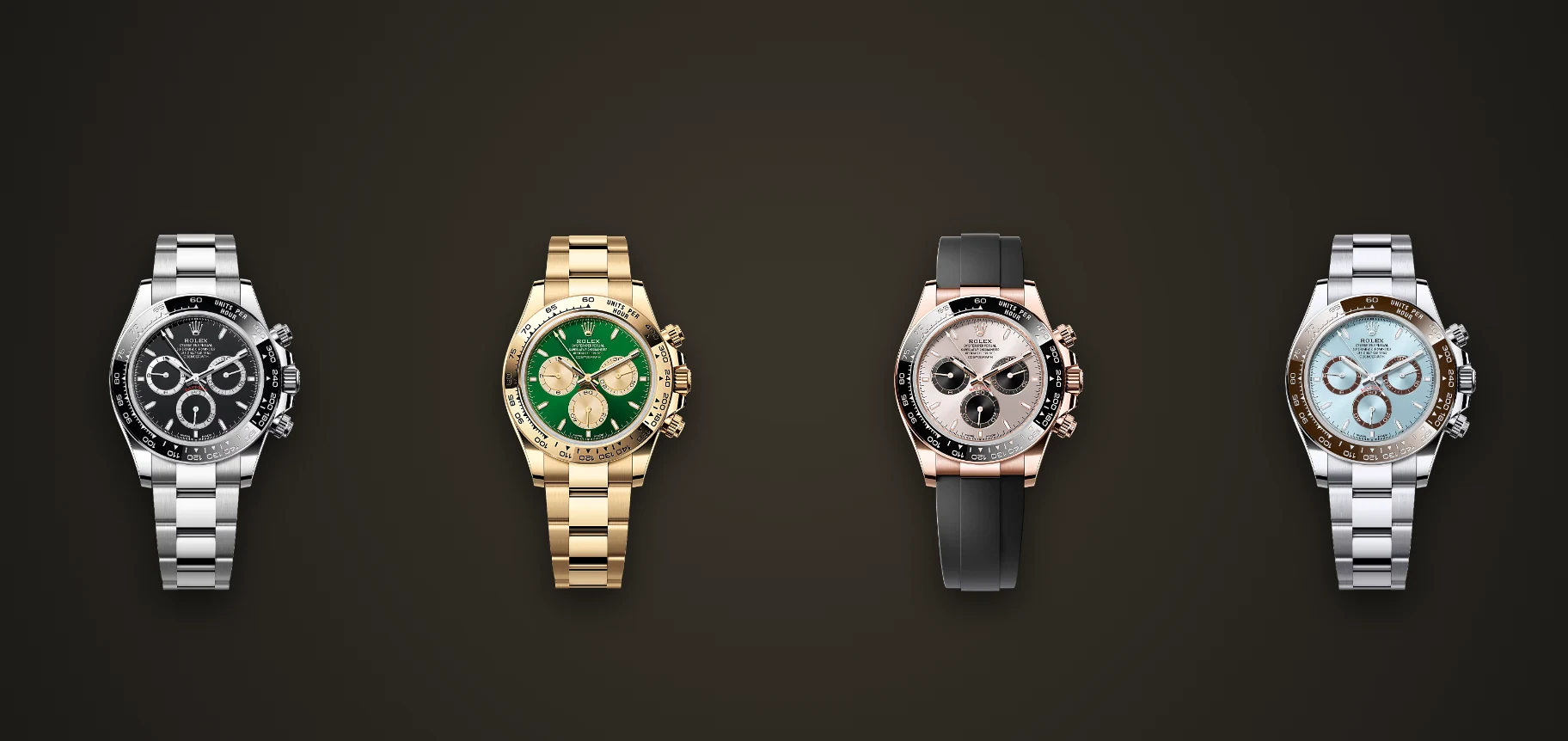
Shop the Rolex Day-Date collection
What should you check before buying a pre owned Day-Date?
A Day-Date is built to last for decades, but a pre owned example is only as good as its history. Work through these checks before you buy.
- Reference and serial number. Make sure the case reference and serial match the warranty card and any service papers.
- Metal and hallmarks. Gold and platinum cases and bracelets carry hallmarks. A genuine Day-Date also feels heavy for its size.
- Bracelet wear. President bracelets can stretch over the years. A little movement between the links is normal; a lot means the bracelet may need work.
- Dial originality. Ask whether the dial is original to the watch, and be careful with refinished or aftermarket dials and diamond settings.
- Day and date change. Both should change cleanly around midnight. Check which language the day wheel uses, too.
- Polishing and service history. Gold is softer than steel, so heavy polishing can blur the case lines and the edges of a fluted bezel. A recent service record is a plus.
- Box and papers. A full set supports the value and makes the watch easier to sell later, but it is not essential if the watch is properly authenticated.
For more detail, read our guides to buying a second hand Rolex and how to spot a fake Rolex.
Day-Date or Datejust: what is the difference?
The 2 models are often confused because they share the same Oyster case shape and Cyclops date. The Datejust shows only the date, and it is made in steel and in Rolesor (steel and gold), with some versions in gold. The Day-Date adds the day of the week in full and is only ever made in gold or platinum. If you want the classic Rolex look in steel, see our Rolex Datejust watches; if you want Rolex’s flagship dress watch, the Day-Date is the one.
How do you sell a Rolex Day-Date in London?
The offer for a Day-Date depends on the reference and metal, the dial, the bezel, its condition, whether you have the box and papers, its service history and current demand for that exact combination. Platinum and the most wanted dials sit at the top; a well worn yellow gold piece without papers sits lower, but it still has a strong resale market.
- Get a free valuation. Fill in the form on our sell my Rolex page with the model, year and condition, and a free, non binding quote follows within 24 hours.
- Bring it in or send it insured. Visit our showroom at Birchin Court, 20 Birchin Lane, London EC3V 9DU, or send the watch fully insured.
- Inspection and final approval. We check the watch, its movement and its paperwork at our head office.
- Get paid. Payment is made by bank transfer on the same day the watch passes final inspection.
You do not need the original box or papers to sell, although a full set raises the offer. If you would rather trade up than sell, our part exchange service puts the value of your Day-Date towards another watch in stock.
Appointments are recommended, particularly for valuations, and you are also welcome to visit the showroom without one during opening hours: Monday to Friday 10:00am to 6:00pm and Saturday 11:00am to 4:00pm.
Key Takeaways
- The Rolex Day-Date is only made in 18 ct gold or 950 platinum, and it shows the day spelled out in full.
- It comes in 36 mm and 40 mm; both current sizes use calibre 3255 with about 70 hours of power reserve.
- The last digit of the reference tells you the metal: 8 is yellow gold, 5 is Everose and 9 is white gold.
- Dial, bezel and metal make the biggest difference to value, so check the dial matches the papers.
- Check bracelet stretch, polishing and service history on any pre owned example.
- You can sell a Day-Date without box and papers, though a full set lifts the offer.
To buy or sell a Rolex Day-Date, browse our Day-Date collection, get a free valuation on our sell my Rolex page or book an appointment at our Birchin Lane showroom.
Frequently Asked Questions
Is the Rolex Day-Date only made in gold and platinum?
Yes. Since its launch in 1956, the Day-Date has only ever been made in 18 ct gold (yellow, white or Everose) or 950 platinum. There is no steel, or steel and gold, Day-Date. If you want a similar look in steel, the Datejust is the closest Rolex model.
What is the difference between the Day-Date 36 and Day-Date 40?
The main difference is size. The Day-Date 36 has a 36 mm case, the size the model was launched with, while the Day-Date 40 arrived in 2015 with a 40 mm case. Current models in both sizes use calibre 3255, with a power reserve of about 70 hours.
Why is the Rolex Day-Date called the “President”?
The name comes from the President bracelet, which Rolex created for the Day-Date when the model was launched in 1956. The bracelet’s semi circular 3 piece links are still fitted to most Day-Date models today, and collectors often use the name for the watch itself.
Can I sell a Rolex Day-Date without box and papers?
Yes. We buy Rolex watches without the original box, warranty card or papers, once the watch has been inspected and authenticated. A full set usually raises the offer, so bring whatever you have, including service receipts.
Where can I buy or sell a Rolex Day-Date in London?
You can buy or sell a Rolex Day-Date at our showroom at Birchin Court, 20 Birchin Lane, London EC3V 9DU. Appointments are recommended, particularly for valuations, and you are also welcome to visit without one during opening hours. Call 020 7867 3801 or start with a free online valuation.